Every company I talk to is racing to deploy AI across their organization. And every one of them is hitting the same wall: their AI is only as good as the knowledge it can access. Feed it outdated policies, conflicting documents, or inaccurate information, and it will confidently distribute those errors at scale.
The rise of Enterprise Search tools has made it easier than ever to connect and unify company knowledge. But there's a fundamental problem these tools don't solve. They can index 100% of your content but verify none of it. Garbage in, garbage out—at scale.
Today, I'm excited to announce a major evolution in how Guru's Knowledge Agents work. They no longer just connect and surface your company's information. They actively verify and improve it.
The Problem We're Solving
Maintaining accurate knowledge has always been manual, time-intensive work. Reading through documents. Checking dates. Archiving outdated content. Constantly re-reviewing for accuracy.
The reality is that manual quality review processes typically reach only 8-12% of organizational content. The rest slowly decays. With 80% of company knowledge existing as unstructured data across document repositories, internal chat tools, meeting recordings, and more, humans simply cannot keep up.
And the stakes have never been higher. Accurate company knowledge isn't just needed by employees to do their jobs—it's the lifeblood of your AI. Agents require accurate context about your company, people, products, processes, and projects. When they get inaccurate information, they don't hesitate or second-guess. They act on it.
How Knowledge Agents Now Work
Knowledge Agents don't just connect your knowledge—they actively improve it. Here's how.
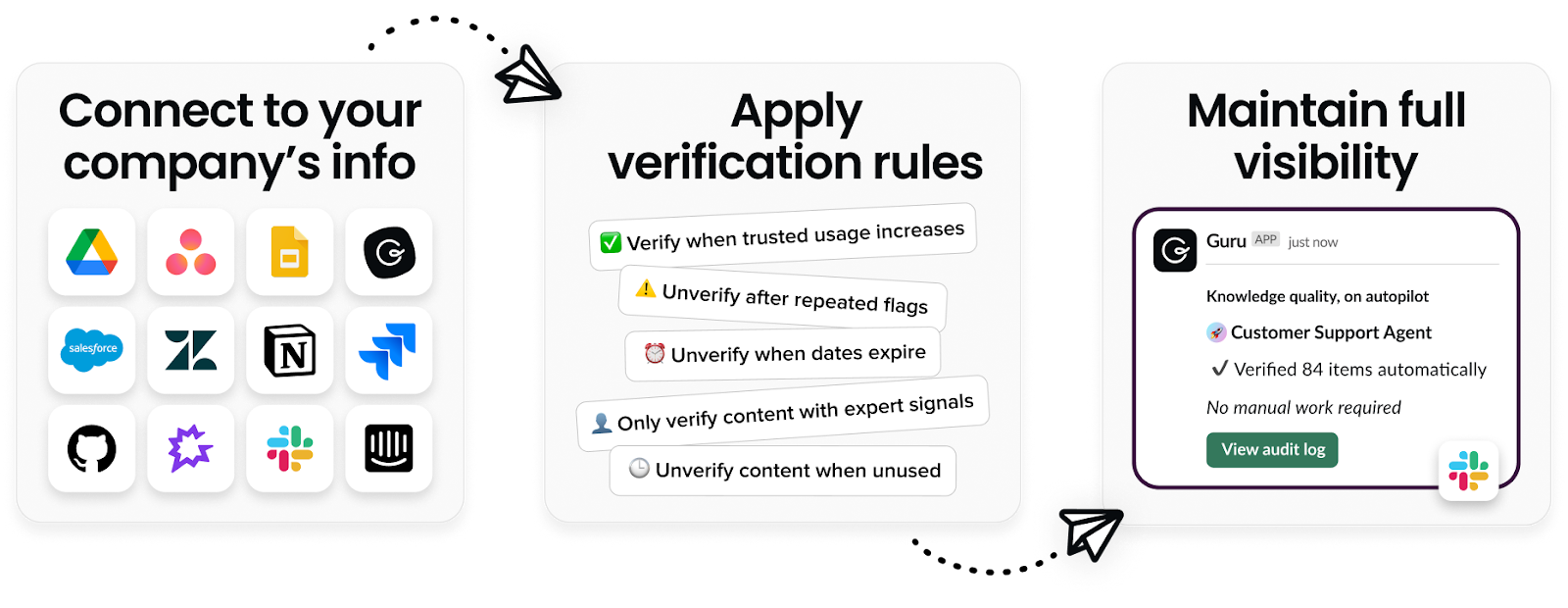
First, you tell your Knowledge Agent what to work on. Connect it to the sources you want it to maintain: document repositories, knowledge bases, meeting recordings, support tickets, or anywhere knowledge lives.
Second, you define your verification rules. Write instructions in natural language that define what makes information verified and accurate versus questionable or outdated. For your most critical content, you can route information to domain experts for human review. For everything else, you can leverage comprehensive automated verification rules—behavioral signals from team feedback, content-based rules for time-sensitive or compliance information, or analytical patterns that surface what's being used and flag what's stale.
Third, you maintain full visibility. As your Knowledge Agent works, it reports every decision it makes. You see exactly why content was marked as verified or unverified, with the ability to review and override any decision at any time.
Verified content is explicitly marked as trusted, so end users understand why they can rely on the answers they receive. Unverified content can be automatically hidden from search results, preventing employees from accidentally using outdated information.
The Multiplier Effect
Here's where the real value compounds. As your Knowledge Agent automatically improves the quality of your underlying knowledge, that work benefits everyone and everything connected to it.
Your employees get better answers. Your AI chat tools get better context. Your agents get more accurate grounding.
Connect Knowledge Agents to all of your other AI tools and agents, and you create an auto-improving, high-quality source of truth. Every verification, every correction, every archived document makes the entire system smarter—for your team and all your AI tools, automatically.
This is what we mean when we talk about Guru as the AI Source of Truth. It's not just about connecting knowledge. It's about building a foundation of verified, accurate information that powers everything your organization does with AI.
Why This Matters Now
The companies winning with AI aren't just the ones deploying the most models or building the most agents. They're the ones who have solved the knowledge problem. They've built systems that ensure every AI-powered interaction is grounded in verified, current, accurate context.
Consider the cost of wrong information: compliance violations from outdated policies, customer churn from incorrect support answers, productivity loss from employees following old procedures. Knowledge Agents eliminate these risks while dramatically reducing the manual effort of content management.
This isn't just about having better documentation. It's about building the trusted foundation that makes AI actually work for your organization.
Every company I talk to is racing to deploy AI across their organization. And every one of them is hitting the same wall: their AI is only as good as the knowledge it can access. Feed it outdated policies, conflicting documents, or inaccurate information, and it will confidently distribute those errors at scale.
The rise of Enterprise Search tools has made it easier than ever to connect and unify company knowledge. But there's a fundamental problem these tools don't solve. They can index 100% of your content but verify none of it. Garbage in, garbage out—at scale.
Today, I'm excited to announce a major evolution in how Guru's Knowledge Agents work. They no longer just connect and surface your company's information. They actively verify and improve it.
The Problem We're Solving
Maintaining accurate knowledge has always been manual, time-intensive work. Reading through documents. Checking dates. Archiving outdated content. Constantly re-reviewing for accuracy.
The reality is that manual quality review processes typically reach only 8-12% of organizational content. The rest slowly decays. With 80% of company knowledge existing as unstructured data across document repositories, internal chat tools, meeting recordings, and more, humans simply cannot keep up.
And the stakes have never been higher. Accurate company knowledge isn't just needed by employees to do their jobs—it's the lifeblood of your AI. Agents require accurate context about your company, people, products, processes, and projects. When they get inaccurate information, they don't hesitate or second-guess. They act on it.
How Knowledge Agents Now Work
Knowledge Agents don't just connect your knowledge—they actively improve it. Here's how.
First, you tell your Knowledge Agent what to work on. Connect it to the sources you want it to maintain: document repositories, knowledge bases, meeting recordings, support tickets, or anywhere knowledge lives.
Second, you define your verification rules. Write instructions in natural language that define what makes information verified and accurate versus questionable or outdated. For your most critical content, you can route information to domain experts for human review. For everything else, you can leverage comprehensive automated verification rules—behavioral signals from team feedback, content-based rules for time-sensitive or compliance information, or analytical patterns that surface what's being used and flag what's stale.
Third, you maintain full visibility. As your Knowledge Agent works, it reports every decision it makes. You see exactly why content was marked as verified or unverified, with the ability to review and override any decision at any time.
Verified content is explicitly marked as trusted, so end users understand why they can rely on the answers they receive. Unverified content can be automatically hidden from search results, preventing employees from accidentally using outdated information.
The Multiplier Effect
Here's where the real value compounds. As your Knowledge Agent automatically improves the quality of your underlying knowledge, that work benefits everyone and everything connected to it.
Your employees get better answers. Your AI chat tools get better context. Your agents get more accurate grounding.
Connect Knowledge Agents to all of your other AI tools and agents, and you create an auto-improving, high-quality source of truth. Every verification, every correction, every archived document makes the entire system smarter—for your team and all your AI tools, automatically.
This is what we mean when we talk about Guru as the AI Source of Truth. It's not just about connecting knowledge. It's about building a foundation of verified, accurate information that powers everything your organization does with AI.
Why This Matters Now
The companies winning with AI aren't just the ones deploying the most models or building the most agents. They're the ones who have solved the knowledge problem. They've built systems that ensure every AI-powered interaction is grounded in verified, current, accurate context.
Consider the cost of wrong information: compliance violations from outdated policies, customer churn from incorrect support answers, productivity loss from employees following old procedures. Knowledge Agents eliminate these risks while dramatically reducing the manual effort of content management.
This isn't just about having better documentation. It's about building the trusted foundation that makes AI actually work for your organization.