Agentic Knowledge Base vs. Enterprise Search vs. RAG
Enterprise search finds documents. RAG grounds answers. An agentic knowledge base governs the knowledge itself. How the three differ and work together.
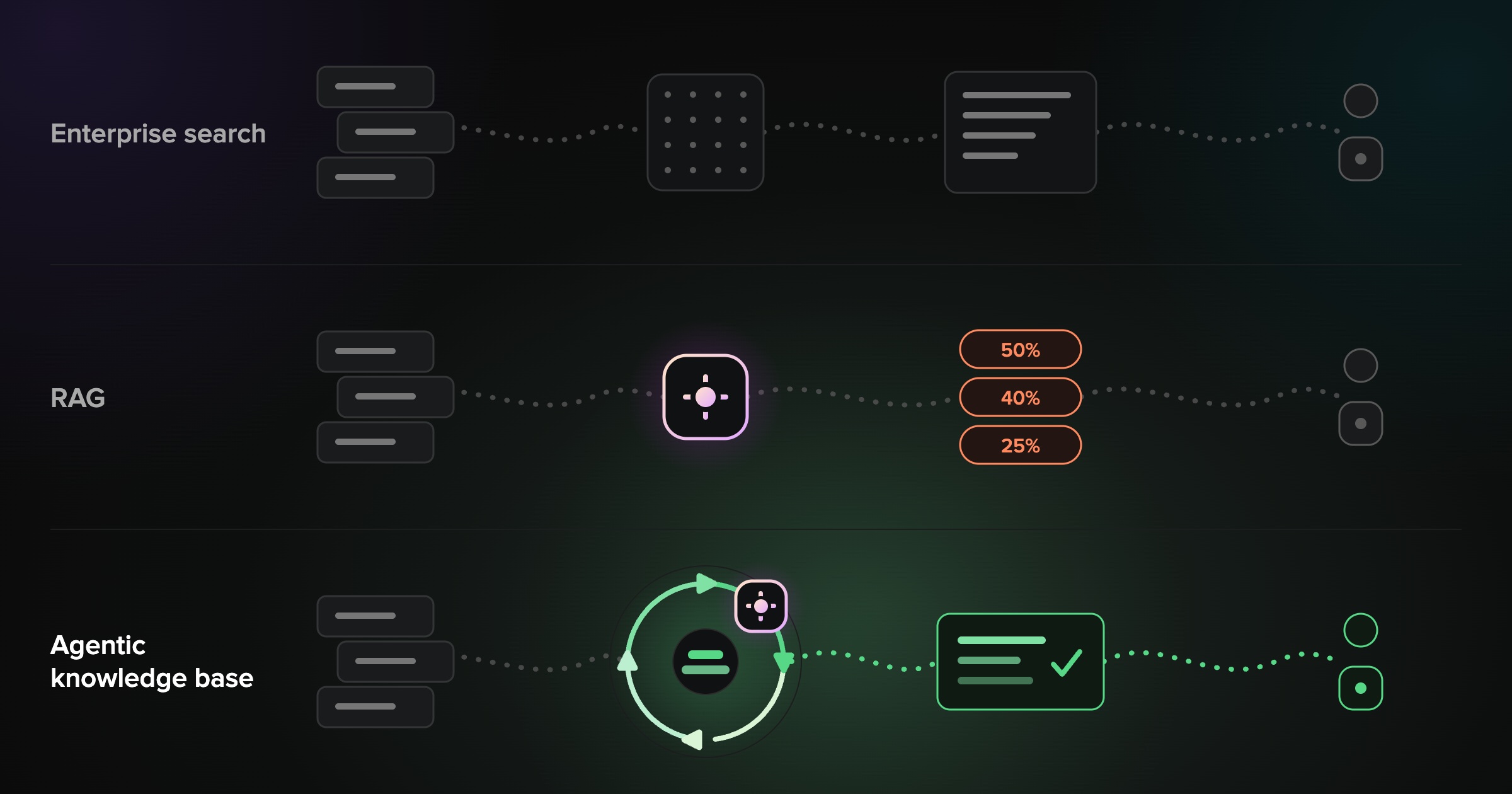
The short answer: enterprise search helps people find documents. RAG (retrieval-augmented generation) feeds retrieved content to an AI model so it can answer. An agentic knowledge base governs and maintains the knowledge itself, discovering, drafting, verifying, and retiring it, so both people and agents draw from one verified source.
These are not three competing products. Search and RAG are retrieval techniques, and Guru uses both. The question that separates outcomes is not which technique you use. It is what the technique is retrieving from.
Here is how the three compare at a glance.
Enterprise search
RAG
Agentic knowledge base
What it does
Finds and ranks existing content
Retrieves content to ground an LLM's answer
Builds, verifies, and maintains the knowledge itself
Optimizes for
Findability
A plausible, grounded response
Accuracy and current state
Judges whether content is correct?
No
No
Yes. Agents verify and unverify content against rules you set, and you choose whether agents can draw on unverified content at all
Human in the loop?
No
No
Yes, by design
Who it serves
People
The model or agent
People and agents
Relationship to the others
An agentic knowledge base makes search results trustworthy
An agentic knowledge base is what a RAG pipeline should retrieve from
Uses both, and governs what they see
What happens between ingestion and retrieval?
Most systems answer "nothing." They connect to your sources, index what's there, and retrieve what matches. That is a real capability, and it is also the whole reason teams end up disappointed. If nothing happens in the middle, then everything stale, duplicated, or contradictory in your systems gets served to your people and your AI as fact.
The three approaches below differ almost entirely in how they answer that one question.
Enterprise search: what it does, and what it can't judge
Enterprise search connects your systems and returns what matches a query. Findability is a real problem and this solves it, which is why search is table stakes rather than a differentiator.
What it doesn't do is tell you whether what it found is current, correct, still approved, or contradicted by something three folders over. It indexes everything and fixes nothing. As the Knowledge Accuracy Gap e-book puts it, these tools don't do anything to improve quality. They just help you find the mess faster.
The lesson teams learn quickly is that connection is not accuracy. Hooking up more sources gives you more to search, not more that you can trust.
RAG: grounded in your data, limited by the state of it
RAG retrieves content from your systems and feeds it to a model so the answer is grounded in your data rather than the model's general training. It works, it's the right architecture, and it is what Guru's own answer generation runs on.
The limit is worth being precise about, because it is not a limit of the technique. Semantic retrieval returns something plausible, not necessarily something correct. Plausibility is a property of the match. Correctness is a property of the underlying content. A retrieval pipeline inherits whatever state your knowledge is in, and it has no way to tell an approved policy from a Slack thread that contradicts it.
"Find yesterday's meeting transcript" works fine. "How do we handle this for a UK customer on our business edition" falls apart, because the right answer changed last week and nobody updated the source. The pipeline will still retrieve the old version and present it with confidence.
The e-book illustrates this with a question any sales team would recognize. Ask "Can we offer a 50% discount to this prospect?" against ungoverned sources and you get five answers from five systems: a Slack message, a meeting recording, a playbook in Drive, a support ticket, and an email thread, citing thresholds of 50%, 40%, 35%, 30%, 25%, and 20%. Every one of them is a genuine document from your company. The retrieval worked perfectly. AI doesn't know which source is authoritative or current, it just retrieves what matches the query.
Better retrieval doesn't resolve that. Neither do context graphs or vector databases. Applied to unverified content, more sophisticated retrieval produces more efficient distribution of inaccurate information. Knowledge accuracy cannot be engineered around.
Why MCP alone isn't enough
A fair question, and increasingly the first one technical teams ask. If an agent can reach every system directly through MCP, why add a layer in between?
MCP is an access and interoperability mechanism. It is genuinely useful and it is not a knowledge-quality system. An agent pointed at raw sources through MCP still has to search five to ten systems live on every question, pull back whatever it finds including the stale and conflicting material, work out relevance, and synthesize an answer from scratch. Then it does all of that again for the next person, because none of the work was kept.
That has a cost. Connecting an agent directly to raw source systems through MCP consumes roughly 5x more tokens than necessary, and the bill grows with adoption. The better your AI rollout goes, the more you pay for the same answers to be reassembled over and over.
Guru can be the MCP server your agents call. The point is what they're calling: a curated layer where the synthesis already happened and the content has already been judged, rather than every raw system at once.
Agentic knowledge base: what it adds to search and RAG
An agentic knowledge base adds the layer the other approaches assume already exists. It keeps the knowledge itself correct and current.
Architecturally it separates two jobs. One layer curates and verifies. A second layer delivers. That separation creates a verified buffer between your raw sources and everyone who consumes them, human or AI, so nothing reaches an answer without having been judged first.
The curation layer runs continuously. Knowledge Agents discover what's missing, draft it, route it to the right expert, publish once it's approved, verify on an ongoing basis, and unverify what's gone stale so agents stop drawing on it. Skills define how an agent does a particular kind of work, automations define when it runs, and permissions govern every step. Rules and behavioral signals handle most of the verification automatically, and the material that needs real expertise routes to the people who have it.
The result is that instead of retrieving from a pile of conflicting content, people and agents pull from one governed source, with a human in the loop wherever accuracy is high stakes.
Using an agentic knowledge base with the search and RAG you already have
This is not an either/or choice, and an agentic knowledge base does not replace the tools you have. It is a verified knowledge layer you connect into the search experiences, RAG pipelines, and agents you already run, through API, MCP, and CLI. We make Claude, GPT, and Copilot work better. We are not competing with them.
Agentic knowledge base vs. enterprise search vs. RAG: which do you need?
If findability is the goal, enterprise search helps.
If you're grounding a model's answers, RAG is the right architecture.
If your answers need to be correct and stay correct as your business changes, the retrieval layer isn't where that gets solved. You have to govern the knowledge itself. That is what an agentic knowledge base does.
Agentic knowledge base vs. RAG FAQs
Does an agentic knowledge base replace our RAG pipeline?
No. It's what your RAG pipeline retrieves from. The pipeline keeps doing its job; the difference is the condition of the content it pulls back.
Can we use this with the enterprise search we already bought?
Yes. A verified knowledge layer connects into existing search experiences through API and MCP, and it makes those results more trustworthy rather than replacing the interface your team already knows.
Isn't this just a knowledge base with extra steps?
The difference is who does the maintenance. A traditional knowledge base waits for people to update it, which is why most of them decay. An agentic knowledge base runs discovery, drafting, verification, and retirement continuously, and brings people in for the judgment calls.
We already connect our agents to everything through MCP. What does this add?
Governance and reuse. MCP gets your agent access. It doesn't tell the agent which of the five answers it found is the current one, and it makes every agent redo the same synthesis from scratch.
The short answer: enterprise search helps people find documents. RAG (retrieval-augmented generation) feeds retrieved content to an AI model so it can answer. An agentic knowledge base governs and maintains the knowledge itself, discovering, drafting, verifying, and retiring it, so both people and agents draw from one verified source.
These are not three competing products. Search and RAG are retrieval techniques, and Guru uses both. The question that separates outcomes is not which technique you use. It is what the technique is retrieving from.
Here is how the three compare at a glance.
Enterprise search
RAG
Agentic knowledge base
What it does
Finds and ranks existing content
Retrieves content to ground an LLM's answer
Builds, verifies, and maintains the knowledge itself
Optimizes for
Findability
A plausible, grounded response
Accuracy and current state
Judges whether content is correct?
No
No
Yes. Agents verify and unverify content against rules you set, and you choose whether agents can draw on unverified content at all
Human in the loop?
No
No
Yes, by design
Who it serves
People
The model or agent
People and agents
Relationship to the others
An agentic knowledge base makes search results trustworthy
An agentic knowledge base is what a RAG pipeline should retrieve from
Uses both, and governs what they see
What happens between ingestion and retrieval?
Most systems answer "nothing." They connect to your sources, index what's there, and retrieve what matches. That is a real capability, and it is also the whole reason teams end up disappointed. If nothing happens in the middle, then everything stale, duplicated, or contradictory in your systems gets served to your people and your AI as fact.
The three approaches below differ almost entirely in how they answer that one question.
Enterprise search: what it does, and what it can't judge
Enterprise search connects your systems and returns what matches a query. Findability is a real problem and this solves it, which is why search is table stakes rather than a differentiator.
What it doesn't do is tell you whether what it found is current, correct, still approved, or contradicted by something three folders over. It indexes everything and fixes nothing. As the Knowledge Accuracy Gap e-book puts it, these tools don't do anything to improve quality. They just help you find the mess faster.
The lesson teams learn quickly is that connection is not accuracy. Hooking up more sources gives you more to search, not more that you can trust.
RAG: grounded in your data, limited by the state of it
RAG retrieves content from your systems and feeds it to a model so the answer is grounded in your data rather than the model's general training. It works, it's the right architecture, and it is what Guru's own answer generation runs on.
The limit is worth being precise about, because it is not a limit of the technique. Semantic retrieval returns something plausible, not necessarily something correct. Plausibility is a property of the match. Correctness is a property of the underlying content. A retrieval pipeline inherits whatever state your knowledge is in, and it has no way to tell an approved policy from a Slack thread that contradicts it.
"Find yesterday's meeting transcript" works fine. "How do we handle this for a UK customer on our business edition" falls apart, because the right answer changed last week and nobody updated the source. The pipeline will still retrieve the old version and present it with confidence.
The e-book illustrates this with a question any sales team would recognize. Ask "Can we offer a 50% discount to this prospect?" against ungoverned sources and you get five answers from five systems: a Slack message, a meeting recording, a playbook in Drive, a support ticket, and an email thread, citing thresholds of 50%, 40%, 35%, 30%, 25%, and 20%. Every one of them is a genuine document from your company. The retrieval worked perfectly. AI doesn't know which source is authoritative or current, it just retrieves what matches the query.
Better retrieval doesn't resolve that. Neither do context graphs or vector databases. Applied to unverified content, more sophisticated retrieval produces more efficient distribution of inaccurate information. Knowledge accuracy cannot be engineered around.
Why MCP alone isn't enough
A fair question, and increasingly the first one technical teams ask. If an agent can reach every system directly through MCP, why add a layer in between?
MCP is an access and interoperability mechanism. It is genuinely useful and it is not a knowledge-quality system. An agent pointed at raw sources through MCP still has to search five to ten systems live on every question, pull back whatever it finds including the stale and conflicting material, work out relevance, and synthesize an answer from scratch. Then it does all of that again for the next person, because none of the work was kept.
That has a cost. Connecting an agent directly to raw source systems through MCP consumes roughly 5x more tokens than necessary, and the bill grows with adoption. The better your AI rollout goes, the more you pay for the same answers to be reassembled over and over.
Guru can be the MCP server your agents call. The point is what they're calling: a curated layer where the synthesis already happened and the content has already been judged, rather than every raw system at once.
Agentic knowledge base: what it adds to search and RAG
An agentic knowledge base adds the layer the other approaches assume already exists. It keeps the knowledge itself correct and current.
Architecturally it separates two jobs. One layer curates and verifies. A second layer delivers. That separation creates a verified buffer between your raw sources and everyone who consumes them, human or AI, so nothing reaches an answer without having been judged first.
The curation layer runs continuously. Knowledge Agents discover what's missing, draft it, route it to the right expert, publish once it's approved, verify on an ongoing basis, and unverify what's gone stale so agents stop drawing on it. Skills define how an agent does a particular kind of work, automations define when it runs, and permissions govern every step. Rules and behavioral signals handle most of the verification automatically, and the material that needs real expertise routes to the people who have it.
The result is that instead of retrieving from a pile of conflicting content, people and agents pull from one governed source, with a human in the loop wherever accuracy is high stakes.
Using an agentic knowledge base with the search and RAG you already have
This is not an either/or choice, and an agentic knowledge base does not replace the tools you have. It is a verified knowledge layer you connect into the search experiences, RAG pipelines, and agents you already run, through API, MCP, and CLI. We make Claude, GPT, and Copilot work better. We are not competing with them.
Agentic knowledge base vs. enterprise search vs. RAG: which do you need?
If findability is the goal, enterprise search helps.
If you're grounding a model's answers, RAG is the right architecture.
If your answers need to be correct and stay correct as your business changes, the retrieval layer isn't where that gets solved. You have to govern the knowledge itself. That is what an agentic knowledge base does.
Agentic knowledge base vs. RAG FAQs
Does an agentic knowledge base replace our RAG pipeline?
No. It's what your RAG pipeline retrieves from. The pipeline keeps doing its job; the difference is the condition of the content it pulls back.
Can we use this with the enterprise search we already bought?
Yes. A verified knowledge layer connects into existing search experiences through API and MCP, and it makes those results more trustworthy rather than replacing the interface your team already knows.
Isn't this just a knowledge base with extra steps?
The difference is who does the maintenance. A traditional knowledge base waits for people to update it, which is why most of them decay. An agentic knowledge base runs discovery, drafting, verification, and retirement continuously, and brings people in for the judgment calls.
We already connect our agents to everything through MCP. What does this add?
Governance and reuse. MCP gets your agent access. It doesn't tell the agent which of the five answers it found is the current one, and it makes every agent redo the same synthesis from scratch.