Guru brings verified company knowledge to ChatGPT and Dots
Give your sales team verified, cited company knowledge in ChatGPT and Dots with the Guru plugin. Guru is a launch partner for OpenAI’s ChatGPT for Sales.
Today we're excited to announce Guru is a launch partner for OpenAI's ChatGPT for Sales, and the Guru plugin is now available to ChatGPT Business and Enterprise teams, including in Dots, OpenAI's new personal agent for work.
With Guru connected, the work sellers do in ChatGPT and Dots draws on the same verified knowledge their company's product and product marketing teams own: what the product does, how to position it, which customer stories fit, and how to win against a competitor. Answers come back cited, permission-aware and current, so every rep and every rep's agents work from the company's best thinking.
Guru supports every team across the enterprise, and today's announcement focuses on what we see sales and go-to-market teams do with it most.
What Guru brings to ChatGPT and Dots
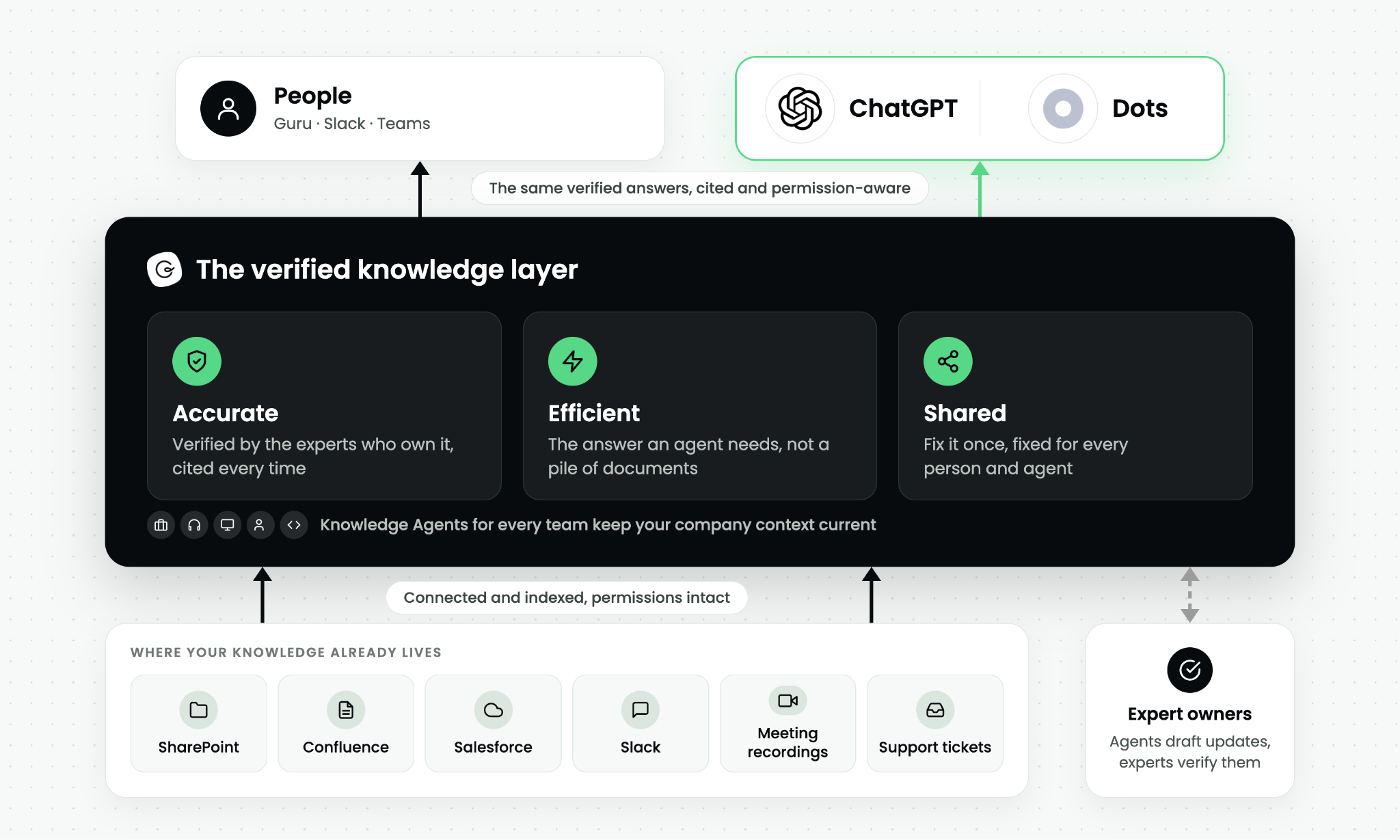
Guru is the self-improving, governed knowledge layer that powers enterprise AI; structuring your company's knowledge, enforcing policy and accuracy automatically, and delivering trusted answers to every person and AI system across your stack.
ChatGPT is where more and more of the workday happens, and Dots takes that a step further by giving every employee a personal agent that gets work done on their behalf. Agents like these are at their best when the company context they draw on is accurate, current and easy to use. That is the job Guru was built for.
Connecting Guru gives ChatGPT and Dots three things:
Accurate context. Answers come from knowledge the experts who own it have verified, with a citation for every claim. Content that is outdated or unverified stays out of the answer.
Efficient context. Guru does the work of finding, filtering and verifying before anything reaches the model, so an agent receives the answer it needs rather than a pile of documents to sort through. That removes a lot of unnecessary token usage: instead of loading pages of raw content into every request and hoping the right detail is in there, ChatGPT and Dots get a precise, verified answer, which keeps responses faster and AI costs down as usage grows across the team.
Shared context. Each employee's dot connects to Guru's Knowledge Agents and calls on them whenever its work needs company knowledge. The dot brings the employee's own context and gets the work done; the Knowledge Agent brings the team's verified knowledge and keeps it current. Because Knowledge Agents are multiplayer, every dot connected to them works from the same answers, and when an owner corrects a knowledge agent once, it is corrected for every person and every agent across the company.
The result is a simple division of labor. ChatGPT and Dots do the work, Guru makes sure the company knowledge behind that work is right, and permissions carry through so people only see what they're allowed to see.
One knowledge layer for every team
In enterprise AI architecture, Guru sits between the systems where knowledge lives and the agents acting on the company's behalf. It connects to the sources teams already use, such as SharePoint, Confluence, Salesforce, Slack, meeting recordings and support tickets, and turns them into context an agent can rely on.
The work inside that layer is done by Knowledge Agents. Guru provides domain-specific Knowledge Agents, each combining a domain's knowledge with the experts who own it. Each one has two jobs:
Keep the knowledge right. Agents gather what teams learn in conversations, calls and tickets, draft updates to documentation, and route them to the owning experts to verify, so knowledge keeps pace as the business changes.
Deliver it wherever work happens. The same verified answers reach people in Guru, Slack and Teams, and reach other AI systems, now including ChatGPT and Dots, through Guru's MCP server.
Support, IT, HR, engineering and sales teams each own their own agents, and every connected AI tool draws from all of them through one connection. More than 2,500 customers use Guru today, and more than 200 unique tools and agents use Guru's MCP server as their governed context layer.
Today's announcement focuses on sales and go-to-market teams, which is where OpenAI's launch centers.
For sales teams: Product Expert and Product Marketer, together
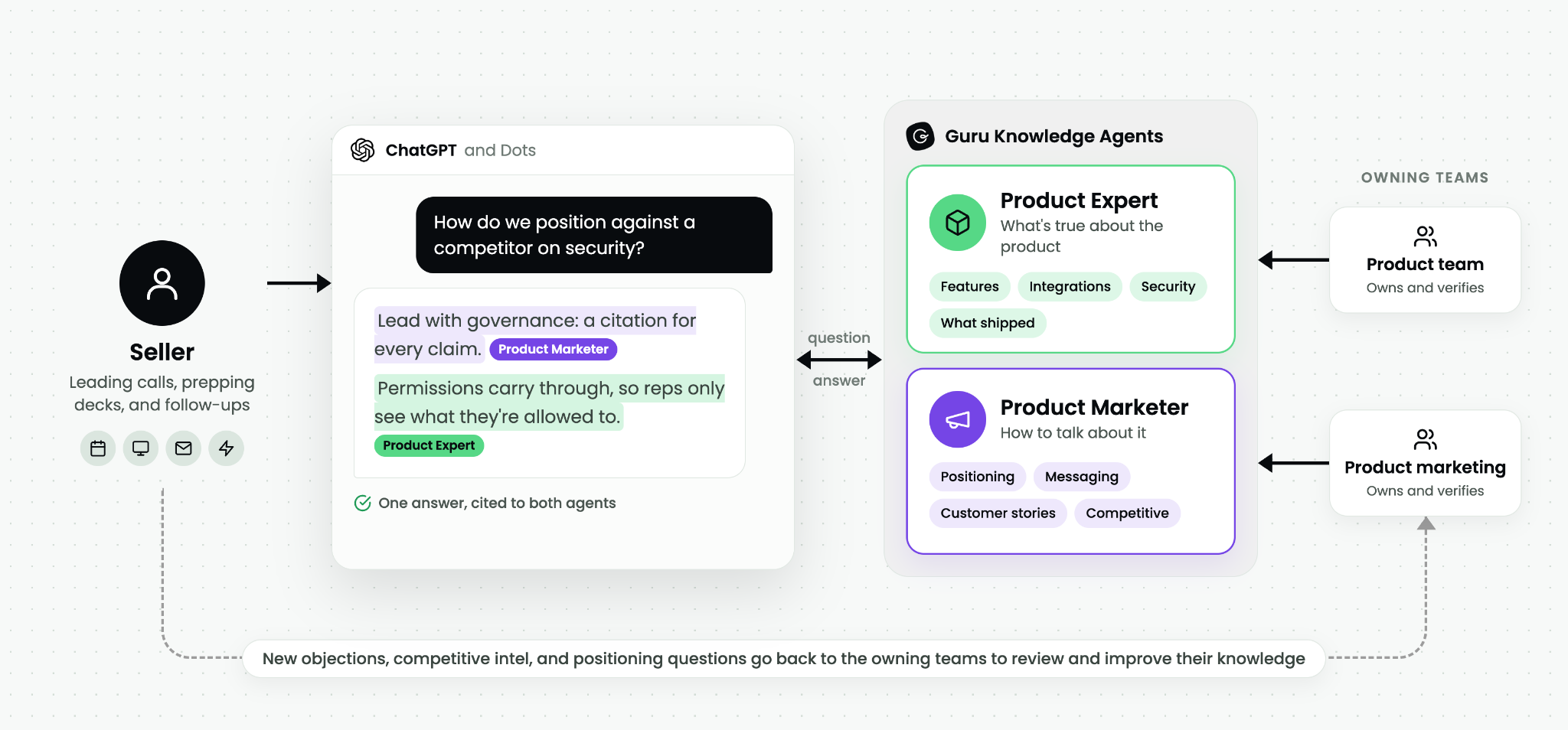
Sellers ask two kinds of questions all day. What's true about our product? And how should we talk about it? Guru answers both through two Knowledge Agents, each owned by the team that knows the answers best.
The Product Expert agent gives sellers verified answers about what the product does, how it works, what it integrates with and what has actually shipped. The product team owns it. Reps can handle technical, security and integration questions in the moment, without waiting on a solutions engineer, and never promise a capability that isn't there.
The Product Marketer agent gives sellers one source for how the company talks about itself: positioning for each buyer and industry, approved messaging, customer stories and proof points, and current competitive positioning. The product marketing team owns it. Every rep sounds like the company, and new positioning reaches every seller the moment it's updated.
The real value shows up when the two work together, because the questions that move deals usually need both. How do we position against a competitor on security? Which customer story proves we can handle this integration? What should I say when their architect asks about permissions? With both agents behind ChatGPT and Dots, sellers get an answer that is accurate about the product and on-message about the story, in one response, with citations to both.
The knowledge also flows the other way. When a rep hears a new objection or a question nobody could answer, their agent can send it back to the owning team as a draft to verify. The product and product marketing teams see what's being asked in the field, and the next seller gets a better answer.
We run our own sales team this way. Our Product Expert and Product Marketer agents are the source for every email, deck, follow-up and competitive answer our team produces, and our AI tools are set to draw from them instead of writing from memory.
What it looks like for a seller
A few moments from a typical week, with Guru connected to ChatGPT and Dots:
Prepping for a call. A rep asks ChatGPT to prep them for tomorrow's meeting with a prospect's IT team. Guru brings the account history, in addition to the right positioning for an IT buyer, a matching customer story, and verified answers to the technical questions raised on the last call.
Building the deck. The rep asks ChatGPT to create ChatGPT slides for the meeting. Guru supplies the approved messaging, positioning for an IT buyer, customer proof points and accurate product details, so the deck says what the company would say. The rep presents it right in ChatGPT, collaborates on it with their team, or exports it to PowerPoint or Google Slides.
Handling a competitor live. Mid-call, the prospect mentions they're evaluating a competitor. The rep asks how to position against them and gets current, approved positioning backed by accurate product facts.
Following up. After the call, the rep asks their dot to draft a follow-up email that answers the architect's questions. The dot pulls verified product knowledge from Guru, and the rep reviews and sends.
Capturing what works. A sales leader hears a rep handle an objection especially well and asks ChatGPT to update the relevant Guru card. The update goes to its owner to verify, and every rep's agent has it from then on.
[Embed 35-second demo video]
Get started
The Guru plugin is available now in ChatGPT for Business and Enterprise teams, and works in Dots wherever your workspace has it enabled. Your admin enables the plugin, sellers connect their Guru account, and their ChatGPT and Dots can draw on the Knowledge Agents your teams already own.
Already a Guru customer? [Setup guide link]. New to Guru? [Talk to our team link] to see how the Product Expert and Product Marketer agents can support your sales team.
Want to learn how Guru can work for you and your team?