
See their story and hear more about it through Guru's Customer Solution Engineer, Steph Hardy, who partnered with Lucia and Perk through every step of the process!
Perk at a glance
- Company: Perk (formerly TravelPerk), a travel and spend platform
- Headquarters: Barcelona
- Support org: 1,100+ frontline agents across 8 global hubs, onboarding 30-50 new hires a week
- Guru customer since: 2022
- Use case: Content redesign and step-by-step process guidance with Guru Knowledge Agent Skills
Results
- ~50% less time spent on content redesign
- 4 tools replaced by 1 skill, in 3 weeks
- 529 cards (45% of the library) redesigned
- Over 7,000 questions from 1,100+ agents in the global launch week
Perk’s knowledge team is three people, and they support more than 1,100 frontline agents across eight global hubs. After two acquisitions and a rebrand, the knowledge base was full of old product names and near-duplicate cards. So the team built its own AI pipeline to rewrite it, using Notion, Make, Gemini, and Google Docs. Three weeks after turning on Guru Knowledge Agent Skills, they shut that pipeline down.
Today, one Knowledge Agent runs two skills. A content redesign skill rewrites cards to a standard format directly in Guru, which cuts redesign time roughly in half. A process guide skill walks agents through complex travel processes one step at a time, right next to the Zendesk ticket.
“We spent weeks building an automation outside our knowledge base to redesign content when big changes hit. Three weeks after turning on Guru knowledge agents, we realized we didn’t need it anymore. It does an incredible job, even on our more complex content.”
- Lucia Delicova, Knowledge & Communications Team Lead, Perk
The Challenge: More Products, More Processes, More Places to Look
A Knowledge Base That Outgrew Its Own Name
In a couple of years, Perk acquired AmTrav to grow its US base, acquired Yokoy to move into expense management, and rebranded from TravelPerk. Each change brought more products, suppliers, and processes for agents to support. The knowledge base filled up with old product names and long, interconnected cards that Perk’s own team described as confusing and repetitive. A single process was often documented separately for each vertical, so agents had to piece together the answer from several near-duplicate cards.
A Redesign Pipeline Stitched Across Four Tools
Lucia Delicova’s knowledge team didn’t wait for a perfect tool. They exported Guru cards as PDFs into a Notion database, where a status change triggered a Make automation that sent each card to Gemini to merge and rewrite. The draft landed in a Google Doc for review, and someone then copy-pasted it back into Guru. It worked, but every handoff was a place to break, and two API bugs eventually took the whole pipeline down. Results also varied by user, language, and model, and it was hard to catch rewrites that oversimplified complex content.
Complex Processes, Scattered Answers
For frontline agents, a cancellation or refund often meant clicking from card link to card link while toggling between supplier sites, Perk's back-end system, and the Zendesk queue. With 30 to 50 new hires onboarding across eight hubs every week, newer agents often didn't know what to ask, so process questions landed in Slack with team leads and peers, delaying the reply to the customer. Perk had also built separate knowledge agents for topics like train and flight cancellations, which meant agents had to decide in the moment which assistant to open.
"If eventually an agent asks five questions and four of them go unanswered because they're not using it properly, they start losing the trust in the tool or they start relying on other colleagues, and that makes mistakes."
- Lucia Delicova, Knowledge & Communications Team Lead, Perk
The Approach: Multiple Skills, One Knowledge Agent, Test & Iterate
Perk built two skills on a single Knowledge Agent: a content redesign skill for the knowledge team that writes the cards, and a process guide skill for the frontline agents who use them. Both went through the same cycle of testing and iteration before rolling out.
1. Content Redesign Skill: A Model Card, One Prompt, Drafted in Guru
With dozens of authors and years of shifting standards, Lucia's team started the content redesign skill by deciding what good looks like before touching a single card. They built a model card that set the titles, sections, steps, and vocabulary, plus which details belong in a red callout, an info box, or a collapsible section.
They used Operator Mode to build a skill that treated this card as the standard to which other cards are modeled. They tested it on their robust, complex content first -- like merging one process that had been documented separately for five verticals into a single card. The logic was simple: if the format worked for the most complex processes, it would work for everything else.
The four-tool, six step content redesign pipeline became a single skill in Guru. An author pastes a card link into the Knowledge Agent chat and asks for a redesign. The skill proposes a new structure in the model card's format, waits for the author's approval, and then writes the draft directly in Guru, with every screenshot left in place for the subject matter expert to check.
Want to build this skill yourself? Paste the template in this help center article into Operator Mode to get started.
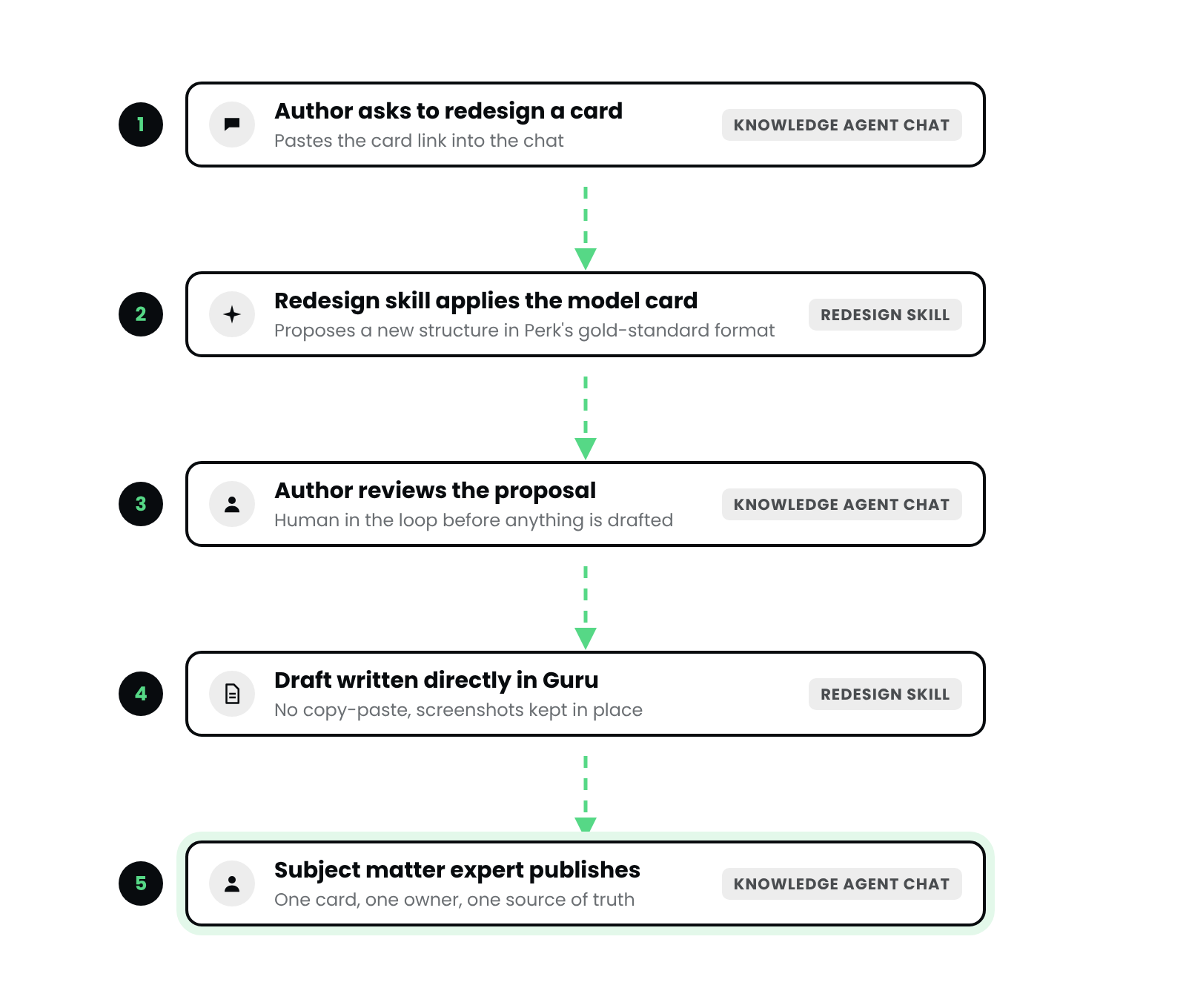
"Instead of having six steps, now we just have one skill."
- Lucia Delicova, Knowledge & Communications Team Lead, Perk
2. Process Guide Skill: One Agent, Step by Step, at the Moment of Need
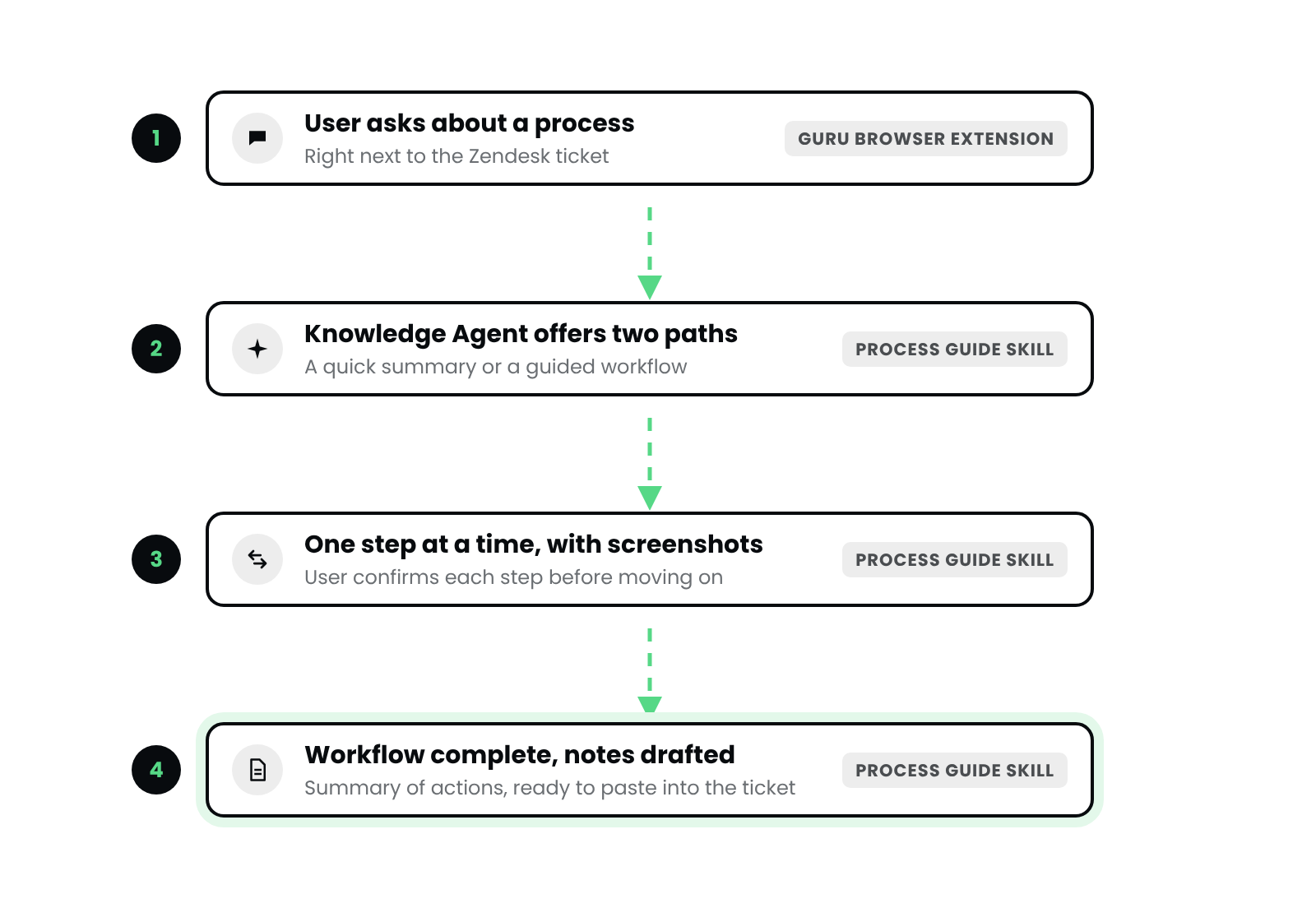
On the frontline, Perk replaced separate topic-specific assistants with one Knowledge Agent running a process guide skill. Agents use it in Guru’s browser extension, next to the Zendesk ticket. When an agent asks something like how to process an airport tax refund for Norwegian, the skill offers the user either a quick summary or a guided workflow. The guided path delivers one step at a time with screenshots, waits for the agent to confirm before moving on, and follows the right branch for each scenario. At the end, it summarizes what was done and drafts the notes to log in Perk's internal system.
It's a decision-tree that follows the right branch for each case.
Want to build this skill yourself? Paste the template in this help center article into Operator Mode to get started.
3. Test & Iterate: How Perk Refined Both Skills
Neither skill was written once and left alone. Both followed the same cycle: test on real examples, change one thing, retest, and only then expand.
- Content redesign skill: a pilot team of three to four authors met weekly to review results, retested every skill change against the same sample card, and tracked AI accuracy as low, medium, or high. Trust grew with every successful test.
- Process guide skill: the team spent about a week testing and honing the skill, rerunning real agent questions to control for variation, then piloted it with agents in one hub before rolling it out to all eight of their hubs.
For both skills, Operator Mode turned every update into a quick conversation with Guru instead of a manual rewrite of the skill instructions.
"Operator mode makes it so easy to make updates to the skills."
- Lucia Delicova, Knowledge & Communications Team Lead, Perk
The result is a full loop of knowledge management: the redesign skill keeps content clean and consistent, and the process guide skill turns that content into confident, step-by-step action for every ticket and question.
The Results
- 🚀 About 50% time saved on content redesign - six steps across four-plus tools became one prompt in Guru, and every big merge saves one to two hours.
- 📈 Up to 60 cards redesigned a week - 529 of 1,148 cards (45% of the library) are already in the new format, with the same quality no matter who runs the skill.
- 📋 7,365 questions from 1,143 agents across 8 hubs in the process guide's global launch week, after a one-hub pilot proved it out.
- 🔥 One agent instead of many - frontline agents no longer have to decide which assistant to open, and every process is explained in the same standard language.
The process guide launched with an 11.7% not-answered rate, and Perk treats that number as a map rather than a verdict. Reviewing those questions showed where agents needed to give more context, so the team added guardrails that prompt agents to share missing details before Guru answers. It also shaped onboarding training for new hires, refresher training for tenured agents, and a list of content gaps for the redesign skill to close.
“So far, everyone’s really happy! It’s doing a really good job!”
- Lucia Delicova, Knowledge & Communications Team Lead, Perk
The same skills that guide agents also show Lucia's team exactly where the knowledge needs to improve next. Authors spend their time reviewing and approving rather than rebuilding cards by hand, and agents get confident, step-by-step answers without leaving the ticket.
What's Next
With the process guide and content redesign skills now the global standard across all eight hubs, Perk is set up to keep building on the same Knowledge Agent. The redesign skill continues working through the rest of the library, the not-answered questions keep pointing to the next gaps to close, and new skills can be added for other teams without spinning up another assistant.
As Perk adds products, suppliers, and regions, their knowledge can now keep pace, and their users can keep getting the right next step wherever they work.
Check out our Skills Library for more inspiration and prompts that make it effortless to get started 🚀
getguru.com - Your AI Source of Truth
Key Stats
Customer Testimonials
Key Takeaways
Guru Capabilities Leveraged
No items found.
Published on
November 6, 2026


