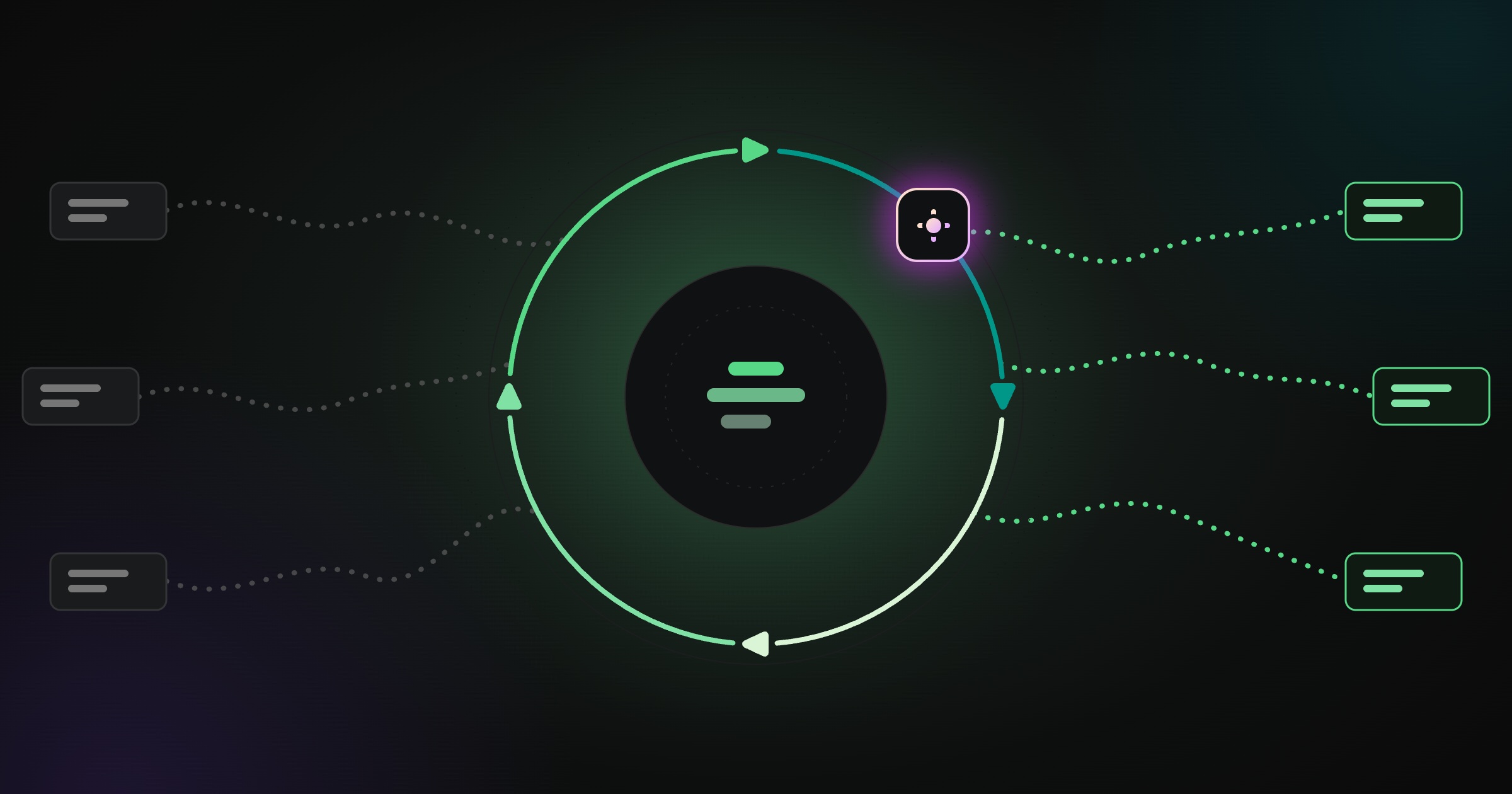
An agentic knowledge base uses AI Knowledge Agents to discover, draft, verify, and retire your company's knowledge automatically. Human directed, agent led.
An agentic knowledge base is a set of AI Knowledge Agent capabilities that automate the full cycle of building and maintaining a company's knowledge: discovering what's missing, drafting it, organizing it, verifying it, and retiring what's gone stale. It is human directed and approved, agent led.
Put simply, a traditional knowledge base is passive. It stores what people write and waits for someone to read it or remember to update it. An agentic knowledge base is active. The agents run the work of keeping knowledge complete and correct, and they pull people in only when a human judgment call is needed.
Why do companies need an agentic knowledge base?
For as long as companies have kept knowledge, it had one audience: people. The job was human from end to end. Capture what people know, keep it current, and help the next person find it. Now there is a second audience, and it is a lot less forgiving. AI agents know nothing about your company, and they act on whatever knowledge they find, whether it's right or not.
Two shifts make this urgent. First, a model is only as good as the knowledge you connect it to. Even the most advanced model will confidently hand out outdated policies, deprecated specs, and conflicting guidance if that is what it finds. Second, most organizations can verify only 8-12% of their knowledge by hand, while AI treats 100% of it as trustworthy. Agents can amplify a single wrong answer 100-1000x, and AI-assisted work now changes information 1.5-2.5x faster than before.
Why manual verification and enterprise search both fall short
Most teams have already tried one of two things, and both hit the same wall from opposite directions.
Assign people to review and verify content, and you get high confidence in what they cover. You also cover 8-12% of it, and that number holds regardless of how many people you add, because the constraint is the time a thorough review takes, not headcount.
Connect everything to enterprise search instead, and you get comprehensive access with no assurance of quality. You can now find every version of the expense policy, including the three that are wrong.
That is the access-quality tradeoff: verified quality for a fraction of your content, or complete access to content you can't vouch for. Neither one gives an AI agent what it needs, which is coverage and confidence at the same time.
What shadow knowledge is, and why it matters for AI
People stop using it. When the official source can't be relied on, teams build their own copies: a doc on someone's desktop, a personal Drive file, a version of the deck only one team uses. Guru calls this shadow knowledge.
It used to be a workaround. Now your AI reads those copies too, and your knowledge team can't see them, review them, or fix them. Once shadow knowledge is ingested by AI systems, it stops being a workaround and becomes an ungoverned production input.
The takeaway is that accuracy, not model choice, is the real constraint on enterprise AI. The fix is not a smarter model. It is governing the knowledge first, then connecting AI to it. Done systematically, that moves verified coverage from 8-12% to 60-80% or better.
How does an agentic knowledge base work?
The two-layer architecture: curation and delivery
The architecture separates two jobs that most systems collapse into one. One layer curates and verifies knowledge. A second layer delivers it. That separation creates a verified buffer between your raw sources and everyone who consumes them, so an agent answering a question is drawing on content that has already been judged, rather than judging it on the fly.
Tools, skills, and automations
Three things define what happens in that first layer. Tools determine what an agent is able to do. Skills determine how it does a particular kind of work. Automations determine when it runs, on a schedule you set. Permissions govern every action at every step.
The six steps a Knowledge Agent runs
Working from that, Knowledge Agents run a continuous loop across the places knowledge actually lives, including work chats, meetings, tickets, and code.
Step
What the agent does
Discover
Watches Slack, Teams, meetings, tickets, and code for what should be captured or updated.
Draft
Writes the update, in your voice, from what it found.
Route
Loops in the person who can actually confirm it's right.
Publish
The change goes live once your expert approves it.
Verify
Articles get checked on an ongoing basis. New decisions in Slack or meetings automatically update existing knowledge.
Retire
Knowledge that's gone stale or stopped getting used gets unverified, so your agents stop drawing on it in their answers.
The agent completes the work from start to finish and pulls in the right team members exactly when it needs them: to answer a question only they can answer, to review a draft, or to approve a change before it publishes.
How you stay in control of an agentic knowledge base
Governance runs on a flexible spectrum you control, from fully human-reviewed for your highest-stakes content to fully automated for high-volume content. You set where each area sits through the tools and skills you enable, the automations you schedule, the permissions you grant, and the quality rules you write in plain language.
In practice that usually lands around an 80/20 split. Rules and behavioral signals handle verification for 60-80% of content automatically. The remaining 20-40%, the material that needs genuine expertise, routes to the people who have it. Legal documentation, compliance policies, clinical protocols, and customer-facing terms sit at the human-reviewed end by default. The point is not to remove people from the process. It is to stop spending their judgment on the 80% that doesn't need it, so they have time for the 20% that does. Humans define the rules, set the thresholds, review the exceptions, and remain accountable for the result.
It runs on Guru's versioning, rollback, and permissions at the collection, folder, and card level. You can always see who changed what and undo it. And the agent only reads what it has permission to see.
AI Guardrails add a second layer of control on the input side, with jailbreak detection and rules you define for what agents will and won't respond to across chat, search, API, and Slack.
How an agentic knowledge base serves both people and AI agents
Knowledge now serves people and agents, and both read from and write to the same governed, permission-aware source of truth. Splintered, per-tool context means every agent you build guesses differently. A shared layer is the only way a whole company stays consistent.
That shared layer is also what makes the effort pay off more than once. Verify a policy today and every connected system benefits at the same time: the support agent, the sales agent, the search bar, and whatever you build next quarter. Verify once, benefit everywhere.
Your knowledge also stays yours. It is portable and reachable by API, MCP, and CLI, and your agents can take action into your other systems, not only into Guru. The verification rules you write, the questions and corrections captured along the way, and the skills you build all belong to you.
Why an agentic knowledge base costs less than connecting agents to every system
Connecting an agent directly to your raw source systems sounds simpler, and it is more expensive than it looks. That agent has to search five to ten systems live on every question, pull back piles of raw documents, and assemble an answer from scratch. Then the next person asks the same question and the whole process runs again, because nothing was kept. That consumes roughly 5x more tokens than necessary.
An agentic knowledge base does the synthesis once and everyone reuses it. Costs stay predictable as adoption grows instead of scaling with it, which matters because the better your rollout goes, the worse the alternative gets.
How an agentic knowledge base improves AI adoption across a company
In most organizations, roughly 5% of people are genuinely good at working with AI, another 20% are getting real value, and the remaining 75% are still early. A blank chat box serves that 5% beautifully. It asks everyone else to already know what's possible, how to phrase the question, and whether the answer coming back can be trusted.
Agents change the shape of that problem. The people who know what good looks like build an agent with the scope, the skills, the sources, and the refusal behavior designed in, and everyone else inherits that expertise the first time they use it. All of it is configured in plain language, so the team that owns the knowledge builds the agent, not IT.
This is also why accuracy and adoption are the same problem. The 75% are the least equipped to catch a wrong answer, so they are the group that stops trusting AI fastest when it burns them.
How an agentic knowledge base gets more accurate over time
Every question, whether asked by a person or another AI, is captured in the AI Agent Center with its status: marked correct, flagged, no answer returned, or unreviewed. The agent reads that record back to close its own gaps and fix flagged knowledge.
To be exact, the agent is not training a model. It is improving the knowledge it runs on, and every improvement is inspectable, versioned, and approved. The more your people and agents use it, the more accurate it gets.
What an agentic knowledge base looks like in practice
100+ source connectors across work chats (Slack, Microsoft Teams), projects (Jira, ServiceNow, Asana, Linear, ClickUp, Notion), support tickets (Salesforce, Zendesk), and meetings (Zoom, Teams, Gong).
Faire reached 93% verified knowledge across its collections.
Perk ran an AI content pipeline across four tools outside Guru. Three weeks after turning on Knowledge Agent Skills, they shut that pipeline down and moved drafting, review, verification, and publishing into a single prompt in Guru.
Agentic knowledge base FAQs
Will an agent publish changes to our knowledge base without anyone checking them first?
Only if you want it to. You choose where you sit on the governance spectrum, from every change reviewed by your team, to agent-drafts-you-approve, to fully automated for lower-stakes content. At every setting, the agent tells you what it did.
Is the agent reading our Slack messages and meeting recordings a form of surveillance?
No. It only reads what the person asking, or the document's owner, could already see. It respects the permissions you have already set, it proposes rather than acts on its own, and it narrates every step.
What tools does this connect to?
Over 100 sources across chats, projects, support tools, and meetings. Your agent can also take action in your other systems through connected MCP servers, including publishing to SharePoint through Microsoft Work IQ.
Is our knowledge locked into Guru?
No. Your knowledge graph is fully available through API, MCP, and CLI, and the knowledge is always yours.
What happens if the agent gets something wrong?
Every answer is logged and flagged if it's wrong, and the agent reads that record back to fix its own gaps. Because everything runs on versioning and rollback, you can always see what changed and undo it.
How is this different from enterprise search or a RAG pipeline?
Does this replace the AI chat tools and agents we already use?
No. It is a verified knowledge layer you can connect into any AI chat tool or agent you already have. It makes Claude, GPT, and Copilot work better rather than competing with them.
See an agentic knowledge base run on your own knowledge
Bring a real Slack channel, a support queue, or a stale collection, and we'll show you what your agent would find, draft, and flag.Talk to a Guru expert →
An agentic knowledge base is a set of AI Knowledge Agent capabilities that automate the full cycle of building and maintaining a company's knowledge: discovering what's missing, drafting it, organizing it, verifying it, and retiring what's gone stale. It is human directed and approved, agent led.
Put simply, a traditional knowledge base is passive. It stores what people write and waits for someone to read it or remember to update it. An agentic knowledge base is active. The agents run the work of keeping knowledge complete and correct, and they pull people in only when a human judgment call is needed.
Why do companies need an agentic knowledge base?
For as long as companies have kept knowledge, it had one audience: people. The job was human from end to end. Capture what people know, keep it current, and help the next person find it. Now there is a second audience, and it is a lot less forgiving. AI agents know nothing about your company, and they act on whatever knowledge they find, whether it's right or not.
Two shifts make this urgent. First, a model is only as good as the knowledge you connect it to. Even the most advanced model will confidently hand out outdated policies, deprecated specs, and conflicting guidance if that is what it finds. Second, most organizations can verify only 8-12% of their knowledge by hand, while AI treats 100% of it as trustworthy. Agents can amplify a single wrong answer 100-1000x, and AI-assisted work now changes information 1.5-2.5x faster than before.
Why manual verification and enterprise search both fall short
Most teams have already tried one of two things, and both hit the same wall from opposite directions.
Assign people to review and verify content, and you get high confidence in what they cover. You also cover 8-12% of it, and that number holds regardless of how many people you add, because the constraint is the time a thorough review takes, not headcount.
Connect everything to enterprise search instead, and you get comprehensive access with no assurance of quality. You can now find every version of the expense policy, including the three that are wrong.
That is the access-quality tradeoff: verified quality for a fraction of your content, or complete access to content you can't vouch for. Neither one gives an AI agent what it needs, which is coverage and confidence at the same time.
What shadow knowledge is, and why it matters for AI
People stop using it. When the official source can't be relied on, teams build their own copies: a doc on someone's desktop, a personal Drive file, a version of the deck only one team uses. Guru calls this shadow knowledge.
It used to be a workaround. Now your AI reads those copies too, and your knowledge team can't see them, review them, or fix them. Once shadow knowledge is ingested by AI systems, it stops being a workaround and becomes an ungoverned production input.
The takeaway is that accuracy, not model choice, is the real constraint on enterprise AI. The fix is not a smarter model. It is governing the knowledge first, then connecting AI to it. Done systematically, that moves verified coverage from 8-12% to 60-80% or better.
How does an agentic knowledge base work?
The two-layer architecture: curation and delivery
The architecture separates two jobs that most systems collapse into one. One layer curates and verifies knowledge. A second layer delivers it. That separation creates a verified buffer between your raw sources and everyone who consumes them, so an agent answering a question is drawing on content that has already been judged, rather than judging it on the fly.
Tools, skills, and automations
Three things define what happens in that first layer. Tools determine what an agent is able to do. Skills determine how it does a particular kind of work. Automations determine when it runs, on a schedule you set. Permissions govern every action at every step.
The six steps a Knowledge Agent runs
Working from that, Knowledge Agents run a continuous loop across the places knowledge actually lives, including work chats, meetings, tickets, and code.
Step
What the agent does
Discover
Watches Slack, Teams, meetings, tickets, and code for what should be captured or updated.
Draft
Writes the update, in your voice, from what it found.
Route
Loops in the person who can actually confirm it's right.
Publish
The change goes live once your expert approves it.
Verify
Articles get checked on an ongoing basis. New decisions in Slack or meetings automatically update existing knowledge.
Retire
Knowledge that's gone stale or stopped getting used gets unverified, so your agents stop drawing on it in their answers.
The agent completes the work from start to finish and pulls in the right team members exactly when it needs them: to answer a question only they can answer, to review a draft, or to approve a change before it publishes.
How you stay in control of an agentic knowledge base
Governance runs on a flexible spectrum you control, from fully human-reviewed for your highest-stakes content to fully automated for high-volume content. You set where each area sits through the tools and skills you enable, the automations you schedule, the permissions you grant, and the quality rules you write in plain language.
In practice that usually lands around an 80/20 split. Rules and behavioral signals handle verification for 60-80% of content automatically. The remaining 20-40%, the material that needs genuine expertise, routes to the people who have it. Legal documentation, compliance policies, clinical protocols, and customer-facing terms sit at the human-reviewed end by default. The point is not to remove people from the process. It is to stop spending their judgment on the 80% that doesn't need it, so they have time for the 20% that does. Humans define the rules, set the thresholds, review the exceptions, and remain accountable for the result.
It runs on Guru's versioning, rollback, and permissions at the collection, folder, and card level. You can always see who changed what and undo it. And the agent only reads what it has permission to see.
AI Guardrails add a second layer of control on the input side, with jailbreak detection and rules you define for what agents will and won't respond to across chat, search, API, and Slack.
How an agentic knowledge base serves both people and AI agents
Knowledge now serves people and agents, and both read from and write to the same governed, permission-aware source of truth. Splintered, per-tool context means every agent you build guesses differently. A shared layer is the only way a whole company stays consistent.
That shared layer is also what makes the effort pay off more than once. Verify a policy today and every connected system benefits at the same time: the support agent, the sales agent, the search bar, and whatever you build next quarter. Verify once, benefit everywhere.
Your knowledge also stays yours. It is portable and reachable by API, MCP, and CLI, and your agents can take action into your other systems, not only into Guru. The verification rules you write, the questions and corrections captured along the way, and the skills you build all belong to you.
Why an agentic knowledge base costs less than connecting agents to every system
Connecting an agent directly to your raw source systems sounds simpler, and it is more expensive than it looks. That agent has to search five to ten systems live on every question, pull back piles of raw documents, and assemble an answer from scratch. Then the next person asks the same question and the whole process runs again, because nothing was kept. That consumes roughly 5x more tokens than necessary.
An agentic knowledge base does the synthesis once and everyone reuses it. Costs stay predictable as adoption grows instead of scaling with it, which matters because the better your rollout goes, the worse the alternative gets.
How an agentic knowledge base improves AI adoption across a company
In most organizations, roughly 5% of people are genuinely good at working with AI, another 20% are getting real value, and the remaining 75% are still early. A blank chat box serves that 5% beautifully. It asks everyone else to already know what's possible, how to phrase the question, and whether the answer coming back can be trusted.
Agents change the shape of that problem. The people who know what good looks like build an agent with the scope, the skills, the sources, and the refusal behavior designed in, and everyone else inherits that expertise the first time they use it. All of it is configured in plain language, so the team that owns the knowledge builds the agent, not IT.
This is also why accuracy and adoption are the same problem. The 75% are the least equipped to catch a wrong answer, so they are the group that stops trusting AI fastest when it burns them.
How an agentic knowledge base gets more accurate over time
Every question, whether asked by a person or another AI, is captured in the AI Agent Center with its status: marked correct, flagged, no answer returned, or unreviewed. The agent reads that record back to close its own gaps and fix flagged knowledge.
To be exact, the agent is not training a model. It is improving the knowledge it runs on, and every improvement is inspectable, versioned, and approved. The more your people and agents use it, the more accurate it gets.
What an agentic knowledge base looks like in practice
100+ source connectors across work chats (Slack, Microsoft Teams), projects (Jira, ServiceNow, Asana, Linear, ClickUp, Notion), support tickets (Salesforce, Zendesk), and meetings (Zoom, Teams, Gong).
Faire reached 93% verified knowledge across its collections.
Perk ran an AI content pipeline across four tools outside Guru. Three weeks after turning on Knowledge Agent Skills, they shut that pipeline down and moved drafting, review, verification, and publishing into a single prompt in Guru.
Agentic knowledge base FAQs
Will an agent publish changes to our knowledge base without anyone checking them first?
Only if you want it to. You choose where you sit on the governance spectrum, from every change reviewed by your team, to agent-drafts-you-approve, to fully automated for lower-stakes content. At every setting, the agent tells you what it did.
Is the agent reading our Slack messages and meeting recordings a form of surveillance?
No. It only reads what the person asking, or the document's owner, could already see. It respects the permissions you have already set, it proposes rather than acts on its own, and it narrates every step.
What tools does this connect to?
Over 100 sources across chats, projects, support tools, and meetings. Your agent can also take action in your other systems through connected MCP servers, including publishing to SharePoint through Microsoft Work IQ.
Is our knowledge locked into Guru?
No. Your knowledge graph is fully available through API, MCP, and CLI, and the knowledge is always yours.
What happens if the agent gets something wrong?
Every answer is logged and flagged if it's wrong, and the agent reads that record back to fix its own gaps. Because everything runs on versioning and rollback, you can always see what changed and undo it.
How is this different from enterprise search or a RAG pipeline?
Does this replace the AI chat tools and agents we already use?
No. It is a verified knowledge layer you can connect into any AI chat tool or agent you already have. It makes Claude, GPT, and Copilot work better rather than competing with them.
See an agentic knowledge base run on your own knowledge
Bring a real Slack channel, a support queue, or a stale collection, and we'll show you what your agent would find, draft, and flag.Talk to a Guru expert →
Vous voulez apprendre comment Guru peut fonctionner pour vous et votre équipe ?