
The 16 Types of Knowledge: A Comprehensive Guide
Knowledge is the engine behind every smart decision, every big idea, every successful strategy—but not all knowledge works the same way. Sometimes it's the step-by-step process written down in a playbook. Other times, it's the gut instinct your most experienced people bring to the table.
When you understand the different ways knowledge shows up across your organization, you can spot the gaps, strengthen collaboration, and tap into the full power of what your team knows. In fact, a Deloitte study found that 75% of organizations believe creating and preserving knowledge is important to their success over the next 12 to 18 months. In this guide, we'll break down the 16 types of knowledge, share clear examples of each, and show how this insight can help your business work smarter, faster, and better.
What are the 16 types of knowledge?
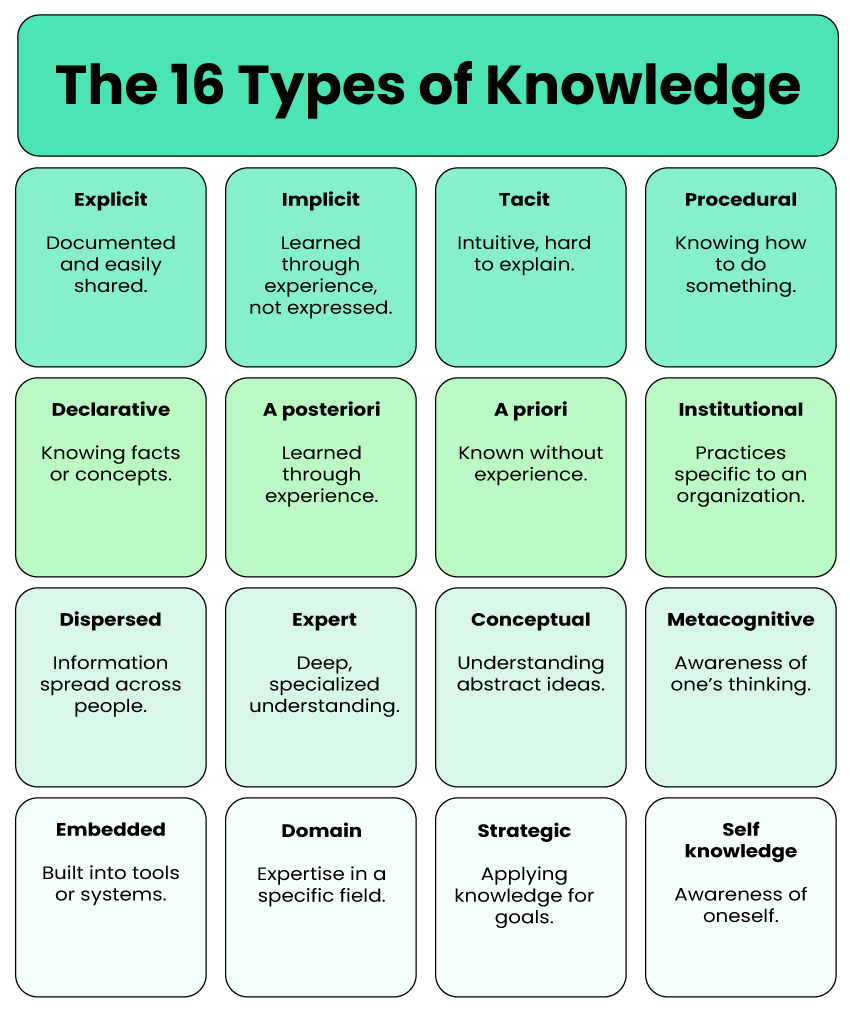
Knowledge types represent different ways information and understanding exist within organizations. These 16 categories help you identify, capture, and manage the full spectrum of knowledge—from documented procedures to expert intuition.
Explicit knowledge
Implicit knowledge
Tacit knowledge
Procedural knowledge
Declarative knowledge
A posteriori knowledge (aka empirical knowledge)
A priori knowledge
Institutional knowledge
Dispersed knowledge
Expert knowledge
Conceptual knowledge
Metacognitive knowledge
Embedded knowledge
Domain knowledge (aka specialized knowledge)
Strategic knowledge
Self knowledge
What is knowledge? (Definition)
Knowledge refers to information, skills, and understanding acquired through experience, education, reasoning, or discovery. Unlike raw data and facts, knowledge represents actionable insights that drive informed decisions and effective problem-solving.
What is another word for knowledge?
Synonyms for knowledge include understanding, expertise, awareness, insight, wisdom, and know-how.
While each of these words has its own nuance, they all relate to the idea of possessing information, skills, or experience. In a business context, terms like "expertise" or "know-how" often highlight applied knowledge, while "insight" and "wisdom" suggest deeper analysis and judgment.
Examples of knowledge
Knowledge encompasses a wide spectrum of understandings, skills, and insights — from simple facts to complex problem-solving abilities. It includes knowing how to ride a bike, remembering the causes of historical events, understanding scientific theories, or mastering a musical instrument. Knowledge can take many forms:
Declarative knowledge — knowing facts, such as the capital of a country or the rules of a game.
Procedural knowledge — knowing how to perform tasks, like baking bread or solving an algebra equation.
Conceptual knowledge — understanding the relationships between ideas, such as how ecosystems function or why certain business strategies work.
Tacit knowledge — intuition, instincts, and experience-based know-how, like recognizing a familiar face in a crowd or sensing the right moment to make a decision.
Whether learned through study, observation, or practice, knowledge shapes how we navigate the world, solve problems, and share ideas with others.
How different types of knowledge work in business
Understanding knowledge types is a practical framework for making your business run smarter. Not all knowledge can be managed the same way.
Key distinctions include:
Structured knowledge: Fits neatly into documents and databases
Experience-based knowledge: Lives in the intuition and expertise of your team
Process knowledge: Requires hands-on approaches like mentorship
By categorizing your organization's knowledge, you identify what's easy to scale and what needs collaborative problem-solving. This builds a more effective knowledge strategy where critical information is captured, shared, and accessible regardless of format.
The 16 types of knowledge
Knowledge comes in many forms—some easy to share, others harder to capture. Here's a breakdown of the 16 key types of knowledge, plus examples of how each one shows up at work.
Explicit Knowledge
Explicit knowledge is easily articulated, written down, codified, and shared. It is the type of knowledge that can be readily transmitted between people through language, documents, or other formalized means.
Because it is structured and recorded, explicit knowledge forms the backbone of training programs, standard operating procedures, and academic research. Organizations often rely on explicit knowledge to ensure consistency, preserve institutional memory, and scale best practices across teams and locations.
Examples of explicit knowledge:
Manuals and guides
Academic papers
Databases
Training materials
Key traits of explicit knowledge:
Systematic
Easy to document and communicate
Often structured in formats like text, diagrams, or formulas
Implicit Knowledge
Implicit knowledge is knowledge that hasn't been formally documented but could be made explicit if captured and shared. It often lives in day-to-day habits, informal practices, and unwritten rules that guide how people work together.
Surfacing implicit knowledge helps organizations identify gaps and opportunities to codify processes for better knowledge sharing.
Examples of implicit knowledge:
Unwritten workflows
Tips shared informally
Preferred ways of using internal tools
Key traits of implicit knowledge:
Not formally codified yet
Transferable through observation or conversation
Often embedded in routines
Tacit Knowledge
Tacit knowledge is personal, experience-based knowledge that is difficult to express or document. It is often developed over time through practice and intuition rather than through formal instruction.
Because tacit knowledge is hard to articulate, it typically spreads through mentorship, coaching, and direct observation.
Examples of tacit knowledge:
A designer's instinct for layouts
A leader's negotiation timing
A chef's flavor balance
Key traits of tacit knowledge:
Hard to articulate
Gained through experience
Shared through mentorship
Procedural Knowledge
Procedural knowledge involves knowing how to perform specific tasks or processes. It includes step-by-step instructions that guide actions and ensure consistency across repetitive tasks. Procedural knowledge is critical for operational efficiency and helps minimize errors and training time.
Examples of procedural knowledge:
Onboarding new hires
Configuring software
Resolving customer issues
Key traits of procedural knowledge:
Action-oriented
Documented as step-by-step instructions
Enables consistent execution
Declarative Knowledge
Declarative knowledge is factual knowledge about "what is true." It refers to information that can be stated clearly, such as data, facts, and general knowledge about the world. Declarative knowledge forms the foundation for understanding more complex concepts and processes.
Examples of declarative knowledge:
Mission statements
Market share data
Compliance requirements
Key traits of declarative knowledge:
Fact-based
Stable over time
Easily communicated
A Posteriori Knowledge (Empirical Knowledge)
A posteriori knowledge is gained through experience, observation, or experimentation. This type of knowledge is empirical in nature, meaning it relies on data and real-world evidence to form conclusions. It is essential for scientific research, testing, and data-driven decision-making.
Examples of a posteriori knowledge:
Learning ROI through testing
Observing customer behavior
Measuring outcomes
Key traits of a posteriori knowledge:
Derived from experience
Empirical and measurable
Supports data-driven decisions
A Priori Knowledge
A priori knowledge is knowledge that exists independently of experience, based on reasoning or logic. This type of knowledge includes mathematical truths, logical deductions, and universal principles that do not require empirical evidence to be validated. A priori knowledge serves as the foundation for many theoretical models and frameworks.
Examples of a priori knowledge:
Mathematical truths
Logical conclusions
Foundational principles
Key traits of a priori knowledge:
Reasoned without observation
Based on logic
Foundational to frameworks
Institutional Knowledge
Institutional knowledge is specific to an organization's history, culture, and processes. It includes the collective experiences, traditions, and know-how that have shaped the organization over time. Preserving institutional knowledge helps prevent the loss of critical insights when key employees leave, a significant challenge given that 35% of professionals cite a frequent shift in roles and positions as a barrier to effective knowledge sharing.
Examples of institutional knowledge:
Policy origins
Backstory of decisions
Awareness of past successes
Key traits of institutional knowledge:
Organization-specific
Formal or informal
Often resides in tenured employees
Dispersed Knowledge
Dispersed knowledge is information spread across many individuals or departments. It often resides in pockets of expertise throughout an organization, making it challenging to access without deliberate collaboration. Harnessing dispersed knowledge improves decision-making and promotes innovation.
Examples of dispersed knowledge:
Regional sales insights
Technical knowledge across teams
Financial allocations
Key traits of dispersed knowledge:
Distributed across teams
Hard to centralize
Revealed through collaboration
Expert Knowledge
Expert knowledge is deep, specialized understanding in a particular field. It is developed through years of practice, formal education, and real-world experience. Expert knowledge is often the source of innovation, leadership, and strategic direction within an organization.
Examples of expert knowledge:
Software architecture
Regulatory compliance
SEO best practices
Key traits of expert knowledge:
Specialized
Gained through experience
Source of leadership
Conceptual Knowledge
Conceptual knowledge involves understanding principles, models, and relationships between ideas. It provides the "why" behind processes and decisions, allowing individuals to connect facts and procedures within a broader framework. Conceptual knowledge is key for problem-solving, critical thinking, and strategic planning.
Examples of conceptual knowledge:
Business models
Strategic frameworks
Scientific theories
Key traits of conceptual knowledge:
Explains "why"
Focused on systems and frameworks
Supports reasoning
Metacognitive Knowledge
Metacognitive knowledge involves awareness of one's own learning processes and strategies. It includes understanding how you learn best, recognizing gaps in your knowledge, and applying effective learning techniques. Metacognitive knowledge enhances adaptability and lifelong learning.
Examples of metacognitive knowledge:
Knowing effective study methods
Recognizing knowledge gaps
Reflecting on performance
Key traits of metacognitive knowledge:
Self-awareness
Supports adaptability
Critical for learning
Embedded Knowledge
Embedded knowledge is knowledge built into systems, products, or processes. It is often operationalized within tools, technologies, and workflows, making it difficult to separate from the infrastructure itself. Embedded knowledge ensures consistency and efficiency across repeated activities.
Examples of embedded knowledge:
Automated workflows
Embedded quality checks
Design specifications
Key traits of embedded knowledge:
Part of organizational infrastructure
Difficult to separate from the system
Operationalized
Domain Knowledge (Specialized Knowledge)
Domain knowledge involves expertise in a specific area or field. It includes the terminology, best practices, and methodologies unique to a discipline. Domain knowledge is crucial for informed decision-making and effective problem-solving within specialized contexts.
Examples of domain knowledge:
Healthcare policy
Financial modeling
Digital marketing
Key traits of domain knowledge:
Field-specific
Critical for informed decisions
Requires continual learning
Strategic Knowledge
Strategic knowledge guides decision-making and planning. It involves understanding long-term goals, competitive landscapes, and market dynamics. Strategic knowledge helps organizations prioritize initiatives, allocate resources, and respond effectively to change.
Examples of strategic knowledge:
Competitive insights
Growth strategies
Market positioning
Key traits of strategic knowledge:
Forward-looking
Supports planning
Drives competitive advantage
Self Knowledge
Self knowledge involves an understanding of one's own strengths, weaknesses, and learning preferences. It promotes personal growth, emotional intelligence, and effective leadership. Self knowledge enables individuals to make informed decisions about their actions and goals.
Examples of self knowledge:
Knowing personal leadership style
Recognizing stress triggers
Understanding motivational factors
Key traits of self knowledge:
Personal
Reflective
Enhances effectiveness and well-being
Applications of the different types of knowledge
Not all knowledge serves the same purpose—but when you understand how each type supports your business, you can put the right information to work where it matters most.
For team alignment and consistency:
Explicit, procedural, declarative, and institutional knowledge
Playbooks, policies, and historical insights
Supports onboarding, collaboration, and repeatable processes
For innovation and deep expertise:
Tacit, implicit, expert, and conceptual knowledge
Lives in the minds of experienced people
Shared through mentorship and thoughtful conversations
For faster decision-making:
Strategic, dispersed, and domain knowledge
Connects market insights with specialized expertise
Helps teams move quickly and confidently
For growth and adaptability:
Metacognitive, self, and embedded knowledge
Understanding learning patterns and system gaps
Builds flexibility for future challenges
What is knowledge acquisition?
Knowledge acquisition is the process of learning, collecting, and developing knowledge through experience, education, observation, or formal training. It's about building understanding that helps people make better decisions and solve problems faster.
Key traits of knowledge acquisition
Continuous and evolving: Ongoing process of learning and improving
Experience and education driven: Combines hands-on practice with formal instruction
Active engagement: Requires applying, testing, and internalizing knowledge
Feedback-based: Uses reflection loops to ensure accuracy and relevance
Problem-solving focused: Equips people with insights for informed choices
Examples of knowledge acquisition
Formal training: Onboarding programs, certifications, workshops
Mentorship: Knowledge transfer through hands-on guidance
Learning by doing: Insights from projects and problem-solving
Documentation: Capturing lessons in wikis and playbooks
Research: Turning observations into actionable insights
Self-directed learning: Independent exploration of new topics
How to manage knowledge
Managing knowledge means making it accessible so people can find and use it, yet this is a common struggle; one study found 29% of employees report it's difficult or impossible to extract the knowledge needed from their company's repositories. Effective knowledge management ensures that the right insights are captured, kept up to date, and accessible—exactly when and where teams need them.
What is knowledge management?
Turning information into action
Knowledge management is the process of creating, organizing, sharing, and maintaining knowledge across your organization. It ensures that important insights don't get lost in inboxes or stuck in people's heads—and that your team always has the trusted info they need to move quickly and confidently.
When it's done well, knowledge management reduces repeated questions, shortens onboarding time, prevents knowledge loss, and keeps teams aligned. For example, a McKinsey study on knowledge brokering found it helped teams design new processes twice as quickly than with conventional techniques.
Turn knowledge into your competitive advantage
Understanding knowledge types transforms how your organization operates and grows. When these knowledge types work together, you prevent information gaps, speed up learning, and empower smarter decision-making. Research shows that when companies prioritize knowledge transfer, 53% of their workers perceive their organisation as more innovative, compared to just 28% at companies without that focus.
Ready to see how Guru creates your AI Source of Truth? Watch our demo now.
Key takeaways 🔑🥡🍕
What are the 4 types of knowledge in Bloom's taxonomy?
How do the 16 knowledge types relate to each other?
What's the difference between knowledge, information, and data?
What means having knowledge?
Having knowledge means possessing information, awareness, or expertise gained through experience or education. It enables individuals to understand concepts, solve problems, and make informed decisions. Some words that mean "having knowledge" include:
- Informed
- Educated
- Learned
- Enlightened
- Well-versed
- Erudite
- Insightful
- Knowledgeable
- Wise
- Savvy
What is an example of knowledge?
An example of knowledge is knowing how to troubleshoot a software issue or understanding your company’s mission statement.
What are examples of common knowledge?
Examples of common knowledge include widely known facts like "water freezes at 32°F" or "the Earth orbits the sun."
What are the 4 types of knowledge with examples?
The four types of knowledge with examples are: explicit knowledge (training manuals), implicit knowledge (unwritten workflows), tacit knowledge (a chef’s instinct for flavors), and procedural knowledge (step-by-step troubleshooting guides).
What is a personal example of knowledge?
A personal example of knowledge could be knowing how to ride a bike or understanding your own learning style.
What are examples of specific knowledge?
Examples of specific knowledge include expertise in financial modeling, coding in Python, or understanding healthcare regulations.
What is the best definition of knowledge?
The best definition of knowledge is information, skills, and understanding acquired through experience, education, reasoning, or discovery.
What is the difference between knowledge and wisdom?
The difference between knowledge and wisdom is that knowledge is the understanding of information and facts, while wisdom is the ability to apply that knowledge with good judgment.
What are the 8 branches of knowledge?
The 8 branches of knowledge often refer to broad academic disciplines like natural sciences, social sciences, formal sciences, applied sciences, humanities, arts, history, and philosophy.
What are the 3 main types of knowledge?
The 3 main types of knowledge are explicit knowledge, tacit knowledge, and implicit knowledge.


